
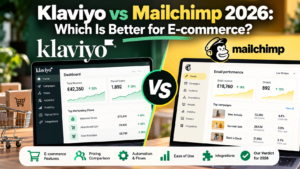
Illustrative image; figures are examples, not measured results
Klaviyo and Mailchimp are two of the most widely used email marketing platforms in the world, and if you are running an e-commerce store, you have almost certainly encountered both. The question of which one to use comes up regularly, particularly for stores that started on Mailchimp and are wondering whether switching to Klaviyo is worth the effort and the cost difference.
This comparison covers the key differences between the two platforms across the areas that matter most for e-commerce businesses, with a straight answer about which one is the better choice and for whom.
The Short Answer
For e-commerce businesses that want to use customer data to drive their email strategy, Klaviyo is the better platform. It was built specifically for e-commerce from the ground up, and that shows in its segmentation depth, automation capabilities, and revenue attribution.
Mailchimp is a better fit for businesses that do not rely heavily on transactional data, for those who want a simpler tool with a gentler learning curve, and for those at the very early stage where cost is the primary consideration.
That said, the right choice genuinely depends on your situation, so the detail below is worth reading before you make a decision.
Background: Two Very Different Platforms
Mailchimp was founded in 2001 as a general-purpose email marketing tool. It has added e-commerce features over the years, but its architecture reflects its origins as a broadcast email platform. It does many things reasonably well for a broad range of businesses.
Klaviyo was founded in 2012 specifically to solve the problem of e-commerce email marketing. Its data model, its segmentation engine, and its analytics are all built around the reality of how e-commerce businesses generate and use customer data. It does fewer things than Mailchimp in the general sense, but it does the e-commerce-specific things significantly better.
Segmentation: Klaviyo Wins Clearly
Segmentation is where the gap between the two platforms is most pronounced, and it is arguably the most important capability for e-commerce email marketing.
Mailchimp’s segmentation works on tags, groups, and a set of pre-defined conditions. You can segment by purchase activity to some extent, but the depth is limited and the segments are not always dynamic in the way that e-commerce requires.
Klaviyo’s segmentation engine lets you filter by almost any combination of customer data: purchase history, product categories bought, average order value, number of orders, last purchase date, predicted next order date, email engagement over any time period, on-site browsing behaviour, customer lifetime value, and dozens of other data points simultaneously. The segments update in real time as customer behaviour changes.
In practice, this means Klaviyo lets you send a campaign to customers who have bought a specific product, have a predicted lifetime value above a certain threshold, have opened at least two of your last five emails, and have not purchased in the last 45 days. The precision of that targeting is simply not available in Mailchimp.
Automation: Klaviyo Leads, Mailchimp Follows
Both platforms offer automation, but the implementations are meaningfully different.
Mailchimp’s automation builder, called Customer Journeys, covers the basics: welcome emails, abandoned cart reminders, post-purchase follow-ups. For many small stores, this is sufficient. The builder is visual and relatively easy to use.
Klaviyo’s flow builder is more powerful and more flexible. You can add conditional splits based on any customer data point, including predicted behaviour. You can combine email and SMS within a single flow. You can use Klaviyo’s predictive analytics to personalise content dynamically. And you can A/B test individual emails within a flow without rebuilding it from scratch.
The practical result is that a well-built Klaviyo automation stack, covering abandoned cart, welcome series, post-purchase, browse abandonment, and win-back, delivers more revenue per contact than the equivalent Mailchimp setup, because the personalisation and timing are more precise.
E-commerce Integrations: Klaviyo Is Built for This
Both platforms integrate with major e-commerce platforms including Shopify, WooCommerce, and BigCommerce. The quality of those integrations is not equal.
Klaviyo’s Shopify integration is deep, reliable, and real-time. Purchase data, browsing behaviour, cart activity, and customer lifetime value sync continuously and are immediately available for segmentation and flow triggers. The integration is maintained by Klaviyo as a core product priority.
Mailchimp’s Shopify integration was actually removed from the Shopify App Store in 2019 following a dispute between the two companies. It has since been restored through third-party connectors, but the native integration is less deep than Klaviyo’s and requires more manual configuration to work reliably.
For WooCommerce and BigCommerce, both platforms offer solid integrations, with Klaviyo generally providing richer data sync and more granular trigger options.
Pricing: Mailchimp Is Cheaper at Low Contact Counts
This is where Mailchimp has a genuine advantage, particularly at the entry level.
Mailchimp’s free plan covers 500 contacts with 1,000 sends per month. Klaviyo’s free plan covers 250 contacts with 500 sends per month. If you are just starting out and cost is the primary consideration, Mailchimp gives you more headroom for free.
On paid plans, Mailchimp’s Essentials tier starts at around $13 per month for 500 contacts. Klaviyo’s email plan starts at $20 per month for 500 contacts. The gap widens at higher contact counts in some ranges and narrows in others, depending on the specific tier.
The cost comparison is not straightforward because the platforms have different features at each tier. What matters is cost relative to the value delivered. For most e-commerce businesses that use automation and segmentation properly, the additional cost of Klaviyo is offset by the additional revenue it generates. For businesses that use email marketing passively, Mailchimp’s lower price is a real advantage.
Ease of Use: Mailchimp Is Simpler to Start
Mailchimp has been around longer and has invested heavily in its user experience. For someone new to email marketing, it is generally easier to get started with than Klaviyo. The interface is intuitive, the templates are polished, and the learning curve is gentler.
Klaviyo has improved its interface significantly in recent years, but it remains a more complex platform because it does more. The flow builder, the segmentation engine, and the analytics are all more powerful than Mailchimp’s equivalents, and power comes with complexity. Most users find that the learning curve is worth it, but it is real.
If you are a first-time email marketer who wants to get up and running quickly with minimal configuration, Mailchimp is easier. If you are willing to invest time in learning a more capable platform in exchange for significantly more powerful tools, Klaviyo is the better long-term choice.
Reporting and Analytics
Mailchimp’s reporting covers the standard metrics: open rates, click rates, unsubscribes, and basic revenue attribution. For most general-purpose email marketing, this is adequate.
Klaviyo’s reporting is built specifically around e-commerce revenue attribution. It tells you exactly how much revenue each flow, each campaign, and each individual email has generated, with attribution windows you can configure. It tracks customer lifetime value, repeat purchase rates, and revenue per recipient across every segment and sequence you run.
For an e-commerce business making decisions about where to invest marketing effort, Klaviyo’s reporting gives you the data you need. Mailchimp’s gives you a less complete picture.
Which Should You Choose?
Choose Klaviyo if:
Choose Mailchimp if:
Switching from Mailchimp to Klaviyo
If you are currently on Mailchimp and are considering switching, the process is straightforward. Klaviyo has a migration tool that imports your contacts, tags, and basic segmentation from Mailchimp. Your purchase history imports automatically if your e-commerce platform integration is set up correctly.
Most businesses that make the switch report that the transition takes a few days to set up properly and a few weeks to fully optimise. The payoff, in terms of more targeted campaigns and higher-performing automation flows, typically justifies the migration effort within the first couple of months.
Klaviyo‘s free plan lets you explore the platform before committing. If you are on Mailchimp and curious whether the switch makes sense, it is worth trying.
Start free with Klaviyo: lifecyclelab.io
No credit card required. Full access to flows and segmentation from day one.